For the past year, pig farmers have been able to calculate the carbon footprint of their production on the QS Climate Platform. However, very few have taken advantage of this service so far – partly because there is little demand for this information further down the supply chain. Why is it still worth addressing this issue?
Carbon footprint, sustainability report, CO₂ balance – pig farmers have been hearing for years that documenting emissions will become standard practice in future. Slaughterhouses, food retailers and banks are said to be increasingly demanding this information in order to meet their own sustainability requirements. Yet on most farms, there is still little sign of this. Specific enquiries from downstream in the supply chain are rare, and it is not possible to achieve any additional revenue from marketing either. This rightly raises the question: why should pig farmers concern themselves with the carbon footprint of their production today? And above all: what concrete benefits does this bring them?

Carbon footprints – not really a new benchmarking tool
There is a direct link between a low carbon footprint and high production efficiency. Around 60 per cent of greenhouse gas emissions in pig production are attributable to feed – which is also the largest cost component. Improved feed conversion therefore reduces both emissions and production costs.
Benchmarking based on the carbon footprint could help to identify and specifically tap into previously untapped potential for greater economic efficiency and climate protection. However, this idea is not new. After all, comparable benchmarking has been taking place in pig farming for decades – using biological and economic indicators such as feed conversion, daily weight gains or mortality rates. Inter-farm performance comparisons, combined with breeding progress, have contributed significantly to the remarkable efficiency gains of recent decades. Ultimately, the carbon footprint simply makes these interrelationships visible through an additional indicator.
German pig production ranks among the most climate-efficient production systems internationally
The direct greenhouse gases methane (CH₄), nitrous oxide (N₂O) and carbon dioxide (CO₂) are key factors in a farm’s carbon footprint. Ammonia (NH₄) is also taken into account, as it can contribute to the formation of climate-relevant N₂O following deposition.
The climate protection study on agriculture in North Rhine-Westphalia provides a prime example of how economically driven efficiency improvements simultaneously reduce the carbon footprint. The increasing adoption of N- and P-reduced feeding has significantly reduced nitrogen excretion. Consequently, fewer ammonia and nitrous oxide emissions are produced through microbial conversion during slurry storage. At the same time, daily weight gains in pig rearing have risen steadily since 1990. Higher productivity spreads the unavoidable emissions across a greater volume of meat produced, thereby reducing the CO₂ footprint per unit of product.
Studies from Canada demonstrate the potential offered by feed management: even a one percentage point reduction in crude protein content can reduce the carbon footprint per kg of live weight by around 10%. The difference between a strongly and a very strongly N/P-reduced diet is roughly of this magnitude.
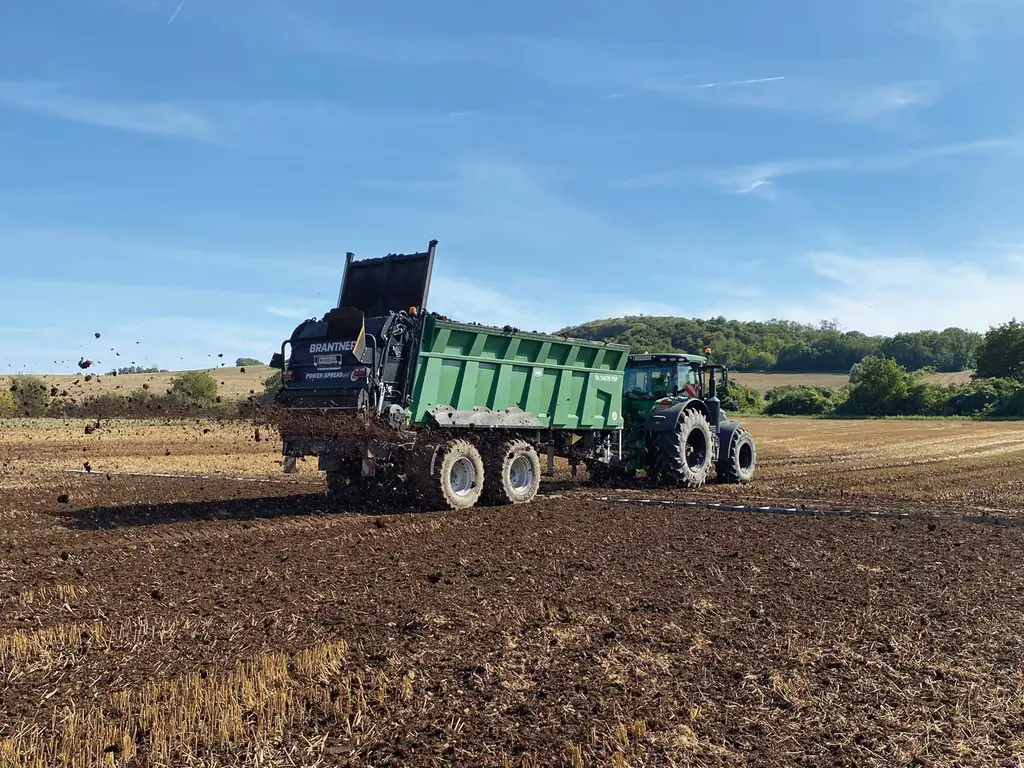
In addition to feeding, the design of the pen floor and manure management are the main factors influencing emission levels. One example is the digestion of manure in biogas plants. In North Rhine-Westphalia, around 16% of manure from fattening pigs has been consistently used for energy since 2014. This helps to reduce methane and nitrous oxide emissions. Exhaust air treatment systems also contribute to reducing emissions by removing ammonia from the air inside the piggery. For North Rhine-Westphalia, the amount of ammonia thus captured is estimated at around 500 tonnes of nitrogen for the year 2021.
The high climate efficiency of German pig production is therefore primarily the result of decades of operational optimisation, but also of environmental regulations. Further improvements are possible, but the individual farm’s carbon footprint is less a key lever for this and more a new form of documentation. Its main purpose at present is to meet the data requirements of slaughterhouses, retailers and financial institutions for their sustainability reporting.
The demand for climate data is on the horizon
Media reports and a shift in the EU’s communication regarding the Green Deal have given the impression in recent months that the pressure on companies regarding sustainability reporting has eased. However, this should not obscure the fact that the European requirements for sustainability reporting remain in place. Only certain deadlines – for example, those for medium-sized companies – have been postponed. It is therefore foreseeable that, sooner or later, the requirements will be passed down the value chain to agricultural businesses.
Another reason for the currently low demand from banks and companies is that, at the outset of their documentation obligations, it is sufficient to rely on standardised figures from the literature to assess emissions from primary production (so-called Scope 3 emissions). However, up-to-date operational data will increasingly be required for reliable monitoring and the documentation of actual improvements. Being prepared for this development should be part of a business’s operations. Even though a carbon footprint assessment does not currently offer any marketing advantage in most cases, it will facilitate access to sales channels and financing in the future.
Furthermore, carbon footprint assessment creates transparency at sector level. It enables an objective comparison of different rearing systems and thus provides a fact-based foundation for the discussion on the future direction of pig farming.

How extensively is the QS Climate Platform being used?
The fact that slaughterhouses have so far only requested carbon footprint assessments on an ad hoc basis is also evident from the level of participation in the QS Climate Platform for Meat. According to QS, since its launch just over a year ago, only a few hundred farms have recorded their data and produced a carbon footprint assessment. However, practitioners estimate that the effort involved is minimal: data entry can usually be completed within 1.5 to 2 hours.
QS expects a gradual increase in the number of participants. “We expect the number of farms to increase as soon as more major buyers start requiring a carbon footprint assessment,” explains Juliane Weinmann, team leader and head of the QS Climate Platform. Whether driven by operational necessity or to meet marketing requirements – sooner or later, many farms will see a tangible benefit from the platform.
One key objective has already been achieved: for the first time, the platform provides the sector with a standardised and harmonised calculation method. Furthermore, the first reliable results are now available. According to QS, the average carbon footprint of the pig fattening farms assessed to date is around 2.9 kg of CO₂ equivalents per kg of live weight. This figure is, in some cases, significantly lower than figures reported in the specialist literature, which, depending on the data source, show values of up to 3.5 kg of CO₂ equivalents per kg of live weight. “This shows just how important the valid and up-to-date collection of CO₂ data can be, even for an overall assessment of the sector,” says Weinmann.
However, it is unclear to what extent the results are already being utilised along the value chain. “We do not track the extent to which participating farms share their results with customers,” explains Weinmann. There are, however, indications from downstream sectors that many livestock farmers are currently still reluctant to share their climate data.
Conclusion
With current pig prices at €1.40/kg carcass weight, carbon footprint assessment is hardly a priority for many pig farmers. In the long term, however, it will become increasingly necessary. German farms have nothing to be ashamed of in this regard: their production is among the most climate-efficient in the world. Further progress is possible, particularly in the areas of feeding and manure management. According to estimates by the Dutch Rabobank, the carbon footprint of pig meat production in Western Europe could fall by a further 22 per cent by 2030. This makes it even more questionable, from a climate protection perspective, to curtail Western European production, as production abroad takes place under less efficient conditions.