


Download print version
Test report 7616
The approval
DLG TestService GmbH awards the test mark DLG APPROVED to the product GRI Green XLR vFLEX 70 (710/70 R 42 & 600/70 R 30) from the manufacturer Global Rubber Industries (Pvt) Ltd. (GRI TIRES).
This certification is based on an independent test conducted in accordance with defined, practical, and scientifically sound DLG testing criteria.
The test evaluates traction, productivity, energy efficiency, soil preservation under verifiable conditions. The results confirm the product characteristics listed in the test report.

Assessment – brief summary
The GRI Green XLR vFLEX 70 is examined as a VF tractor tire in a technical comparison test against a standard tire from a European premium manufacturer serving as the reference tire and additional VF comparison tires. The assessment covers traction, productivity, energy efficiency and soil preservation.
Under the tested conditions, the GRI Green XLR vFLEX 70 achieves at least equivalent or better results than the reference tire in traction, productivity and energy efficiency. At comparable drawbar forces, the resulting mean slip is lower, while effective speed and area performance are higher. Specific fuel consumption and fuel consumption per unit area are also lower.
A soil-preservation advantage cannot be demonstrated.
Overall result: The GRI Green XLR vFLEX 70 shows a balanced performance profile, with clear advantages in traction, productivity and energy efficiency. The soil-preservation advantage of VF technology could not be confirmed. The assessment was carried out on dry soil only, whereas this benefit is typically more pronounced on moist or soft soils.
Table 1: DLG Quality Profile
| DLG QUALITY PROFILE | Evaluation* | |
| Criterion 1: Traction | Effective transfer of engine power to the ground for maximum work performance and efficiency in the field. | ■■■■■ |
| Criterion 2: Productivity | Efficiency in converting engine power in the field for higher working speeds. | ■■■■■ |
| Criterion 3: Energy efficiency | Fuel consumption under realistic operating conditions depending on the module in the field and/or on the road. | ■■■■■ |
| Criterion 4: Soil preservation | Impact on soil structure to ensure long-term soil fertility. | ■■■■■ |
The product
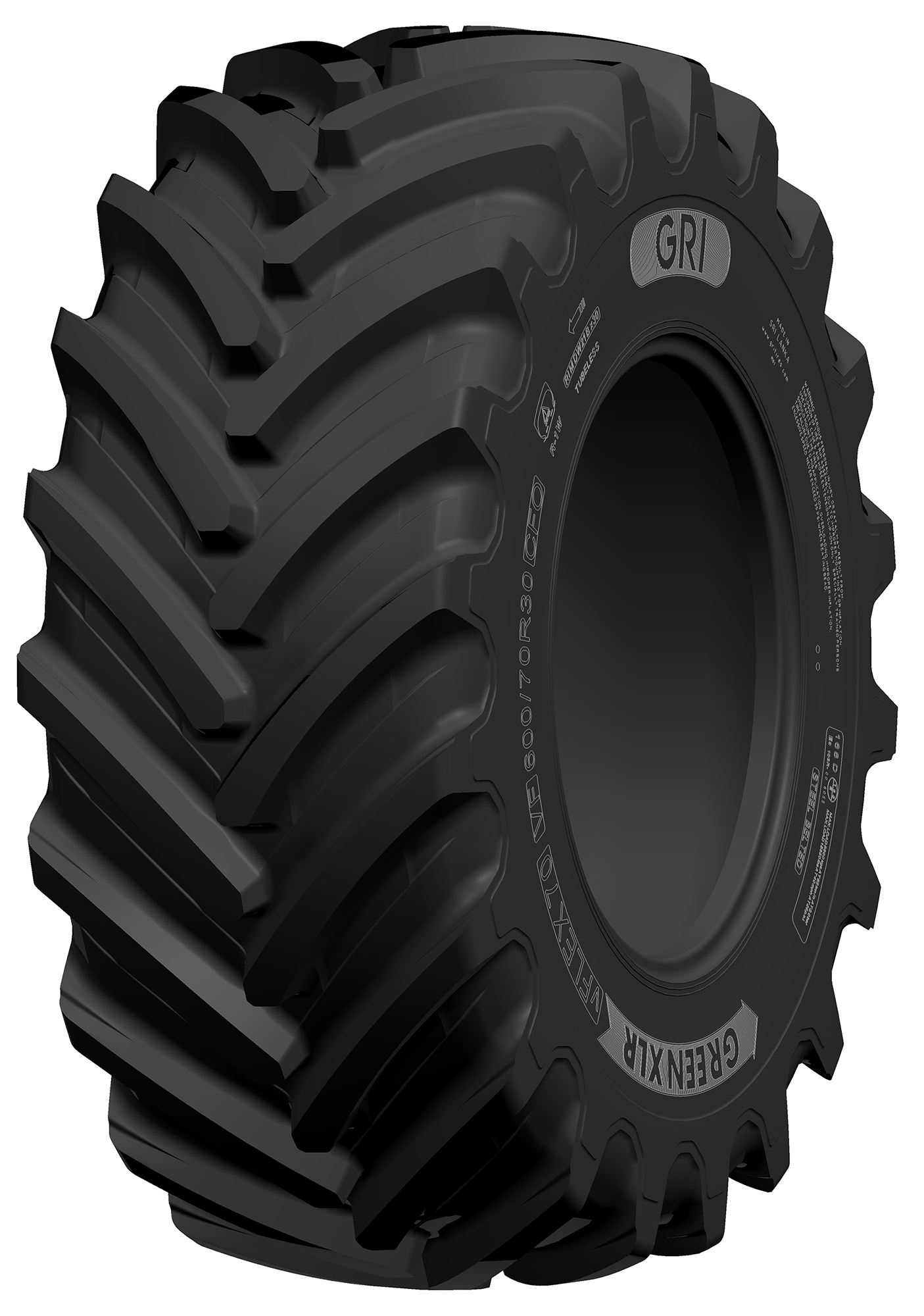
Description and technical data
The following VF tire combination for the front and rear axles is tested:
- Rear axle: GRI Green XLR vFLEX 70 710/70 R 42
- Front axle: GRI Green XLR vFLEX 70 600/70 R 30
Product description and technical specifications
The manufacturer describes the tire combination as suitable for demanding applications, including soil tillage and road transport. The wide footprint is intended to provide high traction on different surfaces. Special mud guards between the lugs and a self-cleaning tread pattern are intended to prevent mud from adhering and to evacuate soil from the tread. The flexible sidewall is intended to increase ride comfort and reduce soil compaction. A targeted arrangement of reinforcement layers is intended to stabilize the tread and prevent stubble damage. The manufacturer also states a long service life and quiet running as further features.
Further information on the tested product is available on the manufacturer’s website: https://www.gritires.com
The method
Test method and comparison basis
The test is conducted in accordance with the DLG tire test framework revised for 2026. The criteria assessed are traction, productivity, energy efficiency and soil preservation. A key feature of the revised test procedure is that the main test tire is compared directly with a reference tire that is also intended to be used in subsequent tests.
The GRI Green XLR vFLEX 70 is tested as the main test tire against a standard reference tire from a European premium manufacturer and three comparison tires from the same VF technology segment. The reference tire is a standard tire and defines the minimum performance requirement for the assessment. The comparison tires provide an additional classification of the main test tire in relation to tires with comparable technology; they do not constitute a minimum requirement.
Good traction performance, as considered in the criteria of traction and productivity, means that a tire transfers the tractor’s drive power effectively to the ground. This enables the tractor to generate higher drawbar forces without excessive wheel slip.
Lower slip at the same drawbar force also results in a higher working speed and therefore greater area performance. Lower slip can additionally reduce energy losses and fuel consumption per unit area, which is assessed under the energy-efficiency criterion. The actual advantage also depends on soil conditions, tire inflation pressure, wheel load and implement.
Soil preservation is another test criterion. It is assessed by measuring soil pressure at defined depths as the tractor passes over the soil. Depending on tire technology, soil pressure may be reduced and the soil structure protected against excessive compaction.
The test results in detail


The test field
The test field is located in the Rhine plain, Bergstrasse district, Hessen, Germany. The soil consists of sandy loam; from a depth of approximately 40 cm onward, it has a high sand content. The previous crop is winter wheat. At the time of testing, the field is in harvested stubble condition. After harvest, the field remains uncultivated and otherwise untreated.
Volumetric soil moisture is measured at the soil surface and at depths of 10 cm and 20 cm. The mean soil moisture is 10% to 12% and is therefore assessed as very low, resulting from a prolonged dry period in 2026. Figure 2 illustrates the soil conditions for this test.
Test combination
The test combination consists of a John Deere 6R215 Direct Drive as the test tractor and a Fendt 1050 Vario as the braking tractor. The test tractor is ballasted to approximately its permissible gross weight of 13 t. It is equipped with a 1.5 t front weight and a 2.2 t rear weight. The braking tractor has a total weight of 16 t during the test. Tire inflation pressures are set according to the manufacturer’s specifications for the respective wheel loads. According to the manufacturer’s specifications, the standard reference tire must be operated at 0.8 bar. Due to their VF technology, the main test tire and the comparison tires can be operated at 0.6 bar at the same wheel load.
Criterion 1: Traction
The assessment of drawbar force–slip behavior is based on mean slip values at defined drawbar forces. Lower slip values are considered indicative of more favorable traction behavior. To relate the drawbar forces to possible typical operations, they are divided into four working segments:
- Light drawbar operations: 10–20 kN - Mowing, milling
- Medium drawbar operations: 30–40 kN - Ploughing, cultivator, milling
- Heavy drawbar operations: 50–60 kN - Ploughing, cultivator
- Maximum drawbar force: 70–80 kN - Traction reserve against getting stuck
Figure 5 shows the results. In light and medium drawbar operations, the main test tire consistently shows lower slip values than the reference tire. In the heavy drawbar-force range, the results are nearly identical, with slightly lower values for the main test tire. At maximum drawbar force, its slip is significantly lower than that of the reference tire.

Criteria 2 and 3: Productivity and energy efficiency
For the investigation, a constant drawbar force of approximately 51 kN is set with the tractor weighing just under 13 t, in order to simulate the work of a 5 m wide implement. Fuel consumption is recorded during the measurements, and the tractor is operated at the same operating point for all tires. At the same drawbar force, the effective vehicle speed is established as a function of the slip generated, resulting in differences in the calculated results, particularly specific fuel consumption, area performance and area consumption. The results for the GRI Green XLR vFLEX 70 are compared with the reference tire, whose values are set at 100%.
The GRI Green XLR vFLEX 70 achieves approximately 2% lower specific fuel consumption than the reference tire. Area performance is approximately 3% higher, while area consumption is approximately 2% lower. Under the tested conditions, the GRI Green XLR vFLEX 70 therefore shows consistently more favorable values than the reference tire for the productivity and energy-efficiency parameters considered.
Table 2: Results for productivity and energy efficiency
| Parameter | Reference tire | GRI Green vFLEX 70 | Comparison tire A (VF) | Comparison tire B (VF) | Comparison tire C (VF) |
| Specific fuel consumption [g/kWh] | 100 % ▶︎ | -2 % ▼ | -2 % ▼ | -1 % ▼ | -2 % ▼ |
| Area performance [ha/h] | 100 % ▶︎ | 3 % ▲ | 3 % ▲ | 2 % ▲ | 3 % ▲ |
| Area consumption [l/ha] | 100 % ▶︎ | -2 % ▼ | -3 % ▼ | -2 % ▼ | -2 % ▼ |

Criterion 4: Soil preservation
To assess soil preservation, soil pressure is investigated at a constant axle load and a driving speed of 5 km/h without applied drawbar force. Soil pressure is measured at depths of 20, 40 and 60 cm. The GRI Green XLR vFLEX 70 is compared with the reference tire; lower soil pressure indicates lower soil loading.
The test is conducted under dry soil conditions. Because the soil layer is strongly consolidated from a depth of approximately 40 cm onward, only the measurements taken at 20 cm soil depth can be used for the evaluation. At this depth, the GRI tire shows higher soil-pressure values than the reference tire. The additional comparison tires serve to provide supplementary classification of the results.
Table 3: Results of soil-pressure measurements at 20 cm depth
| Parameter | Reference tire | GRI Green vFLEX 70 | Comparison tire A (VF) | Comparison tire B (VF) | Comparison tire C (VF) |
| Rear axle | 100 % ▶︎ | +11 % ▲ | +9 % ▲ | -9 % ▼ | -31 % ▼ |
| Front axle | 100 % ▶︎ | 5 % ▲ | -14 % ▼ | -29 % ▼ | -19 % ▼ |
Scope and limitations of the test
The results provide an initial practical indication of the performance of the GRI Green XLR vFLEX 70 within the tested framework: new tires on a dry, sandy-loam test field. Supplementary tests on different soil types and moisture levels, with worn tires or on other tractors can show the extent to which the results transfer to additional agricultural operating conditions.
The GRI Green XLR vFLEX 70 shows an overall balanced performance profile in the comparison test. Compared with the standard tire from a European premium manufacturer used as the reference, it achieves at least equivalent and, in several drawbar-force ranges, more favorable traction results. The GRI Green XLR vFLEX 70 shows lower slip values in light and medium drawbar operations and at maximum drawbar force; in the heavy drawbar-force range, the results for both tires are close.
The GRI Green XLR vFLEX 70 also achieves more favorable results than the reference tire for productivity and energy efficiency under the tested conditions. At the same drawbar force, the effective vehicle speed varies depending on slip. As a result, the GRI Green XLR vFLEX 70 achieves higher area performance, lower specific fuel consumption and lower fuel consumption per unit area.
However, the soil-preservation advantage of VF technology could not be confirmed. The assessment was carried out on dry soil only, whereas this benefit is typically more pronounced on moist or soft soils.
Overall, the GRI Green XLR vFLEX 70 performs particularly well in traction, productivity and energy efficiency within the tested framework. The assessment of soil preservation is limited, as evaluable measurements are available only at a soil depth of 20 cm under the selected test conditions.
Manufacturer and applicant
Global Rubber Industries (Pvt) Limited,
28, Joseph’s Lane,
Colombo 04, Sri Lanka
Test execution
DLG TestService GmbH, Gross-Umstadt location, Germany, in cooperation with the Kiel University of Applied Sciences, Faculty of Agriculture, Dept. Agricultural Engineering
The tests are conducted on behalf of DLG e.V.
Department
Vehicle Technology – Performance Testing
DLG test framework
DLG tire test 1.0-2026
Test Engineers
Dipl.-Ing. (FH) Hans-Joachim Tauber,
Dipl.-Ing. (FH) David Herrmann
Soil pressure measurements carried out by: Berner Fachhochschule (BFH)
Contact
DLG TestService GmbH - Groß-Umstadt location • Max-Eyth-Weg 1 • 64823 Groß-Umstadt • Tel: +49 69 24 788-600 • tech@DLG.org