

PotatoEurope and SugarBeet Expo 2026: Keeping Root Crops Competitive and Profitable
9 and 10 September 2026 in Springe near Hanover, Germany – 20th anniversary of PotatoEurope and premiere of SugarBeet Expo – DLG President Hubertus Paetow: Production systems must be made resilient for global and on-farm competition – Around 290 exhibitors present solutions for future-proof potato and sugar beet value and production chains – www.potatoeurope.de – www.sugarbeet-expo.de
PotatoEurope 2026 and the inaugural SugarBeet Expo officially opened on Wednesday, 9 September, at Rittergut Gestorf estate in Springe near Hanover, Germany, creating a joint platform for the potato and sugar beet value chains. While PotatoEurope celebrates its 20th anniversary this year, SugarBeet Expo is being held for the first time. As a combined platform for two economically significant root crops, the outdoor exhibition occupies a unique position in Europe.
The focus of PotatoEurope and SugarBeet Expo, which are organized by DLG (German Agricultural Society), is on solutions for efficient, resource-conserving and climate-adapted root crop production. In his opening address, President of the DLG, Hubertus Paetow, who farms in northern Germany,
, emphasized that the sector must adapt its production systems to changing climatic and economic conditions and requires practical technologies, innovative research and reliable policy frameworks to do so. Volatile markets and the effects of climate change are realities to which the sector and individual farms must respond through efficient and competitive production processes.
In his welcoming remarks at the opening of PotatoEurope and SugarBeet Expo, Paetow noted that potatoes and sugar beet have historically generated strong returns and have contributed significantly to risk diversification and business stability on farms. Today, however, heat, drought and invasive pests are placing increasing pressure on both crops and their value chains.
According to Paetow, ensuring the long-term viability of potato and sugar beet value chains is a priority extending well beyond the sectors themselves. Together, the two crops account for around 16 percent of the turnover generated by German crop production. Potatoes and sugar beet have long been important energy sources in Germany and Europe and therefore make a significant contribution to food security.
Adapting Production Systems to Drought Conditions
“Our main task at present is to adapt our production systems,” stressed the DLG President.
Climate change has become a reality in agriculture far faster than many expected. Against this backdrop, farms, agribusinesses and researchers must secure yields and quality under changing conditions, from crop rotations and day-to-day crop management to variety selection.
“We can defend ourselves against drought and bacterial diseases through adapted production technologies,” Paetow stated. In addition, potato and sugar beet production require further advances in resistance breeding and crop protection policies that enable growers to respond appropriately to pest and disease pressure.
Reliable Insecticide Strategies Needed for SBR and Stolbur
Paetow emphasized that further action is needed in addressing SBR and Stolbur diseases and their vector, the reed glass-winged cicada, which can cause significant yield losses.
Agriculture requires practical and reliable insecticide strategies, he said. Moving “from one emergency authorization to the next” is the opposite of reliability and planning certainty.
At the same time, experiences in tackling the SBR and Stolbur complex demonstrate that systematic action and cooperation among farmers, industry, advisors, research institutions and developers can produce sustainable solutions. What is needed is an innovation-friendly and research-oriented policy environment that is also willing to allow new approaches where appropriate.
Global Market Sets the Benchmark for the Sugar Sector
Market conditions, however, cannot be directly controlled by farmers, agribusinesses, researchers, politicians or public administrations. In this context, Paetow referred to the volatile situation on the liberalized and globally influenced sugar market.
“Since the end of the EU sugar regime, the world market has become our benchmark,” he said.
Following the crisis years from 2023 to 2025, global sugar prices have stabilized again at relatively low levels. However, Paetow noted that these prices are below the level at which sugar can be produced economically within the European Union, given prevailing land, labour and energy costs.
This is currently being felt particularly strongly by sugar beet growers in southern regions, where drought conditions during the summer of 2026 severely affected crops.
“When yields are disappointing, what was once a flagship enterprise can become a burden,” Paetow said.
The potato market is different, having long been accustomed to price fluctuations. Regional market dynamics create a balancing relationship between yields and prices. As a result, there is hope that, following last year's downturn, profitability may improve in the coming season.
Experiencing New Systems Under Real Farming Conditions
For both crops, however, one thing remains clear from the farm perspective: if potatoes and sugar beet are to continue making a meaningful contribution to farm income, production must remain competitive both within the farm business and on international markets. Accordingly, PotatoEurope and SugarBeet Expo focus strongly on developments in production systems.
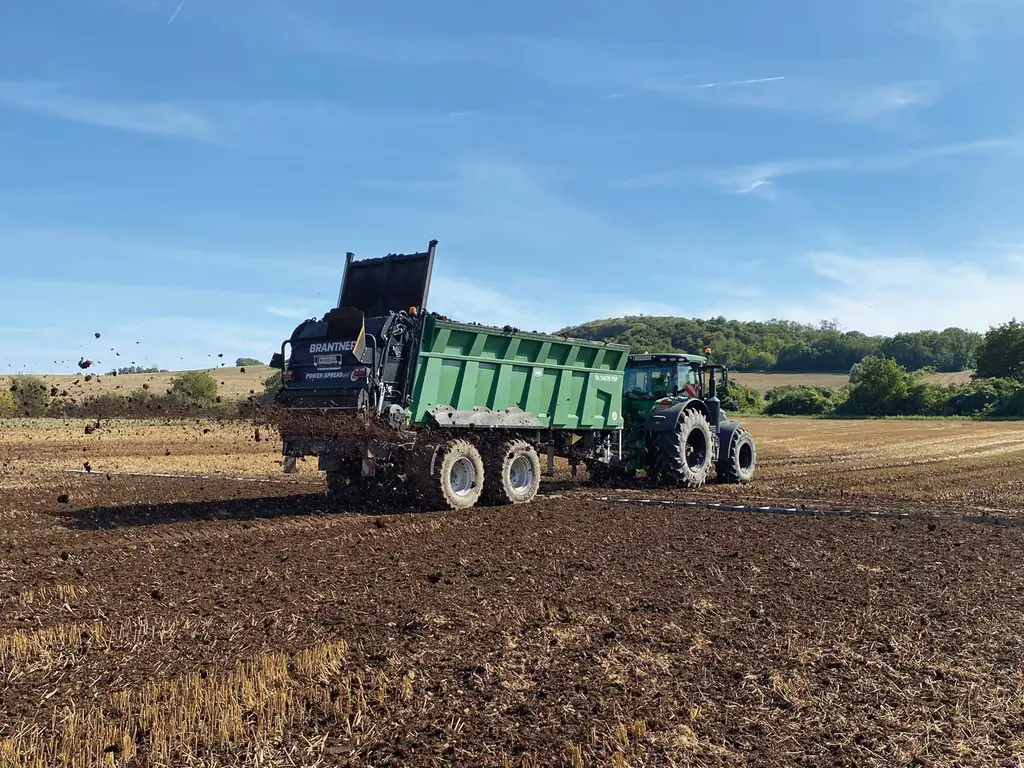
The outdoor exhibition provides the ideal setting to examine new technical solutions, innovations and cultivation concepts under real operating conditions. Over the two-day event, industry participants have the opportunity to discuss new concepts and technologies in the context of volatile markets, climate adaptation and growing demands for efficiency, competitiveness and productivity.
Highlights include the latest solutions for precision planting and sowing, harvesting, transport, cleaning and loading.
Trial fields and demonstration plots allow direct comparison of varieties as well as fertilization and crop protection measures.
Digitalization, automation and robotics also have the potential to reduce production costs, alleviate labour shortages and strengthen farm resilience.
About PotatoEurope and SugarBeet Expo
DLG is organizing PotatoEurope and SugarBeet Expo on 9 and 10 September 2026 at Rittergut Gestorf estate in Springe near Hanover, Germany.
PotatoEurope covers the entire potato value chain, while SugarBeet Expo focuses on modern sugar beet production, including soil health, machinery, digitalization, robotics and climate-adapted production systems.
The technical programme includes machinery demonstrations, trial fields, demonstration plots, the DLG Expert Stage, and dedicated Spotlights on Digital Farming, Agricultural Logistics and Organic Potato Production.
The State of Lower Saxony is the exclusive partner of both exhibitions
The German Potato Industry Association (UNIKA) is the institutional partner and initiator of PotatoEurope 2026, while Golden Geest-Kartoffeln Erzeugergesellschaft mbH serves as regional partner.
The German Sugar Industry Association (WVZ) is the institutional partner of SugarBeet Expo, with Nordzucker AG acting as regional partner.
Case IH is the event’s exclusive tractor partner
Images may be used free of charge when credited as “DLG / T. Jaworr”. Additional images will be made available during the course of the morning.
The institutional partner of SugarBeet Expo is the Wirtschaftliche Vereinigung Zucker e. V. (WVZ), with Nordzucker AG serving as regional partner. Case IH is the exclusive tractor partner of the event.
Media contact
Malene Conlong
+49 69 24788-237
m.conlong@dlg.org
DLG. Progress and sustainability in the agriculture and food industry
The DLG (German Agricultural Society), founded in 1885 by Max Eyth, stands for productivity and sustainability in innovation-driven improvements in agriculture and the food chain. The aim of the DLG is to promote progress through the transfer of knowledge - especially with regard to technology and quality control. Non-profit, politically independent and with an international network, the DLG has more than 30,000 members worldwide.
As one of the leading organizations in its sector, the DLG not only organizes trade fairs and events in the fields of agriculture and food technology but also tests food, agricultural technology and equipment. With its competence centers for agriculture and food, its demonstration farm where practical trials take place along with its numerous publications, the DLG continually promotes independent knowledge transfer. In addition, the DLG works on numerous national and international committees of experts to develop solutions for the challenges facing agriculture and the food industry.
www.dlg.org
20260909_DLG-PotatoeSugarBeet_JAWORR_037.jpg