

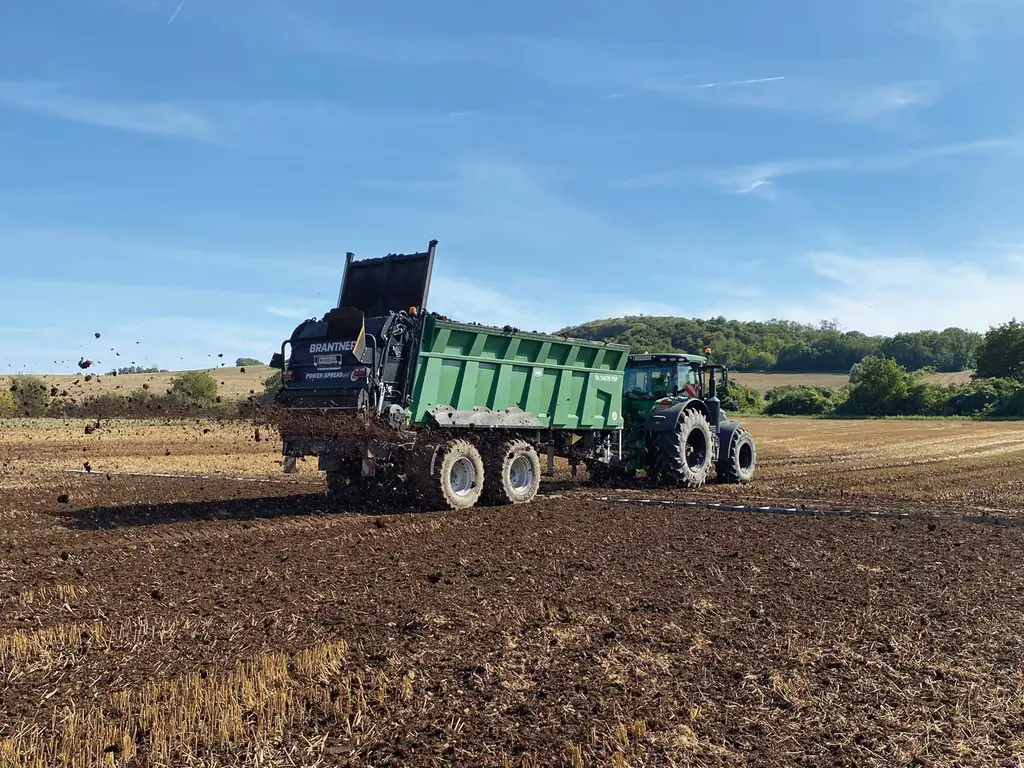

Behind the EAF network are farmers from across Europe, each bringing their own experience, challenges and perspectives to modern agriculture. With this interview series, we want to introduce the people behind the network, highlight the realities of their day-to-day work, and share how international exchange can strengthen farming across Europe.
This time, Arina van Schaik, farmer from Hungary, gives insight into their farm, the decisions they face, and the wider developments shaping European agriculture today.
Please introduce your farm briefly.
My husband and I run an arable farm in western Hungary and produce wheat, barley, rapeseed, corn, soya beans and pumpkin seed for oil production. Our farm started small in 1998, and today we work on more than 1,400 ha.
What makes managing an arable farm today fundamentally different from five years ago?
Five years ago, it was 2021, and we thought that after corona — which did not affect our daily work on the farm as much as it did in other sectors — the world would return to ‘normal’.
We could not foresee that the economic effects of war(s) and politics on product prices and input costs, and the reality of climate change, would affect us so extremely and so quickly as they did.
We live in uncertain times, and therefore it is important to spread risk and to be flexible. After almost 30 years, we have enough reserves not to be blown away by a few windy years.
As a farm manager, what is the most complex decision you have to make repeatedly every season?
Finding the optimum between efficiency and effectiveness is complex. There is a lot of information available – collected data, experience, knowledge, advice –, which, after thorough analysis, can lead to optimal and specific plant and soil treatment. On the other hand, we have to deal with available manpower, machinery and ever-changing weather conditions. Finding the right compromise in time, money and effect is a challenge.
Which decisions before harvest have the biggest financial impact on your business?
Strategic long-term decisions have the biggest financial impact in agriculture, not minor yearly changes. Our long-term strategy is to maximize yield quantity and quality on our farm with top technology and highly effective and efficient use of inputs. We invested, and still invest, a lot in the newest technology like machinery, storage and irrigation as well as in soil quality – manure, lime, cultivation, drainage. Tax laws and overall agricultural politics in Hungary and the EU have supported continuous investment as well.
This means our general production costs are high, and we are therefore vulnerable to extreme weather conditions resulting in low yields. Drought and heat in summer are especially a risk. If you have a financial minus on 250 ha of corn, you need to compensate for this with maybe 150 ha of winter crops’ balance, and then 400 ha of work still results in zero profit.
How do you balance operational efficiency with risk management when harvest conditions are uncertain?
Flexible machinery is important. We have a dryer, so if rain is coming, we can start wheat harvesting early at 16 to 17% moisture content and dry it. Our long-term cooperation with a local contractor assures us that, in uncertain conditions, he brings an extra combine to speed things up. The use of several smaller combines instead of one big one also ensures that, in the case of technical problems, at least some harvesting will be done.
Some farmers believe they are not complete without their own combines; we see it as an advantage that our contractor does the harvesting with his own experienced drivers. Experienced, competent drivers are the best guarantee against technical problems and accidents.
Furthermore, the whole process of transport, quality and quantity measurement, cleaning, drying and storage is again up to date: best technology, maximum automation and flexibility, e.g. more storage lines and extra vehicles. We also have a well-equipped workshop for quick repairs. Harvesting but also seeding is like top sport — something you prepare for all year long. Every step in the process should be in top form: plants, fields, machines, staff, storage.
How has volatility in input costs changed the way you design your arable system?
If long-term (luxury) improvement inputs like extra potassium for our potassium-fixating soil or special lime products are extremely expensive, we skip them for a year or choose less in quantity or quality. Essential measures, however, are always taken in full, and we have not changed our intensive production strategy until today.
In one sentence: what makes European exchange essential for modern arable farming?
In my opinion, all forms of exchange always improve things: they make you reflect on your own situation, they inspire you, and therefore improve your decisions.
Interview: Clara Albrecht, DLG e.V.


